Have you ever heard of Whitfield Diffie or Martin Hellman?
Like Alan Turing, they're experts in cryptography and cryptanalysis. They might not be household names in the same way, but it's likely that you've unknowingly engaged with their work if you've ever gone online shopping – or just used the internet in general. (Cue cryptographers yelling, "they're household names here, thank you very much!")
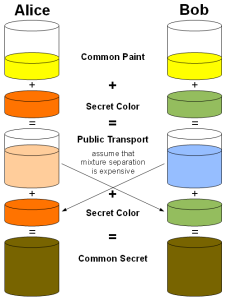
That's because they developed the Diffie-Hellman (DH) key exchange algorithm, which allows information to be exchanged securely even in cases where you don't have a secure communication channel. Rather than relying entirely on difficult-to-manage private keys (pieces of information used to encode or decode), it allows some keys to be disclosed publicly. Users can then combine their own private keys with these public keys to unlock the information they need. It's also possible to illustrate the concept using colours and the "Alice and Bob" profiles – two names that often come up in examples of cryptographic theory.
What does this have to do with translation?
Well, the Diffie-Hellman method happened to be the subject of a text we worked on recently: computer science is a theme we frequently come across in our technical translation work. As all good translators should, the team members who worked on the text researched the subject and looked at the profiles of Whitfield Diffie and Martin Hellman. You'll notice that the latter uses the spelling "Hellman", not the more common "Hellmann". What caught our translators' attention, however, was that the source text had in fact used "Hellmann" – every single time the name came up.
And that's exactly where the skills of a good human translator kick into gear. Our expert translators were able to advise the customer that they had corrected the mistake as they were working on the translation – and that the customer should revisit the German text to make the amendments on that end, too. This customer uses machine translation (MT) for some of its projects, but identifying a mistake like this is something an MT tool still can't do, even all these years into the technology's development. Worse still, some MT tools still get confused when encountering names that are also everyday nouns, so Harald Jäger might be transformed into Harald Hunter, for example.
Expert translation adds value
The fix wasn't difficult, but it's a prime example of something a human translator will pick up that a machine translation or AI tool won't. Crucially, it also added value for the customer, who thanked the translators for their thorough research. A good translator will read up on things and check that names have been spelled correctly – you'd be amazed how often people and place name misspellings are uncovered once translators start examining texts – while a machine translation tool will lift the name from the source text and plonk it in the translation.
To lend credibility to the text you're having translated, ideally it won't contain any spelling errors in the first place – particularly not in the names of the key people in the article (who, as it happens, are key people in both senses of the word here). Mistakes are a fact of life, however, and picking up on mistakes involving spelling is just one example of where a human eye adds value.
Drop us a line or follow and message us on LinkedIn if you'd like us to turn our expert eyes to your important technical documentation.